7 Safety Risks to Know Before Pool Equipment Repair in Pinellas County
Pool equipment repair carries real hazards: trapped pressure, live wiring, stored chemicals, and gas lines. Check these seven risks before opening any pump, filter, or heater in Pinellas County.
Published
Part of our Pool Equipment Repair service.
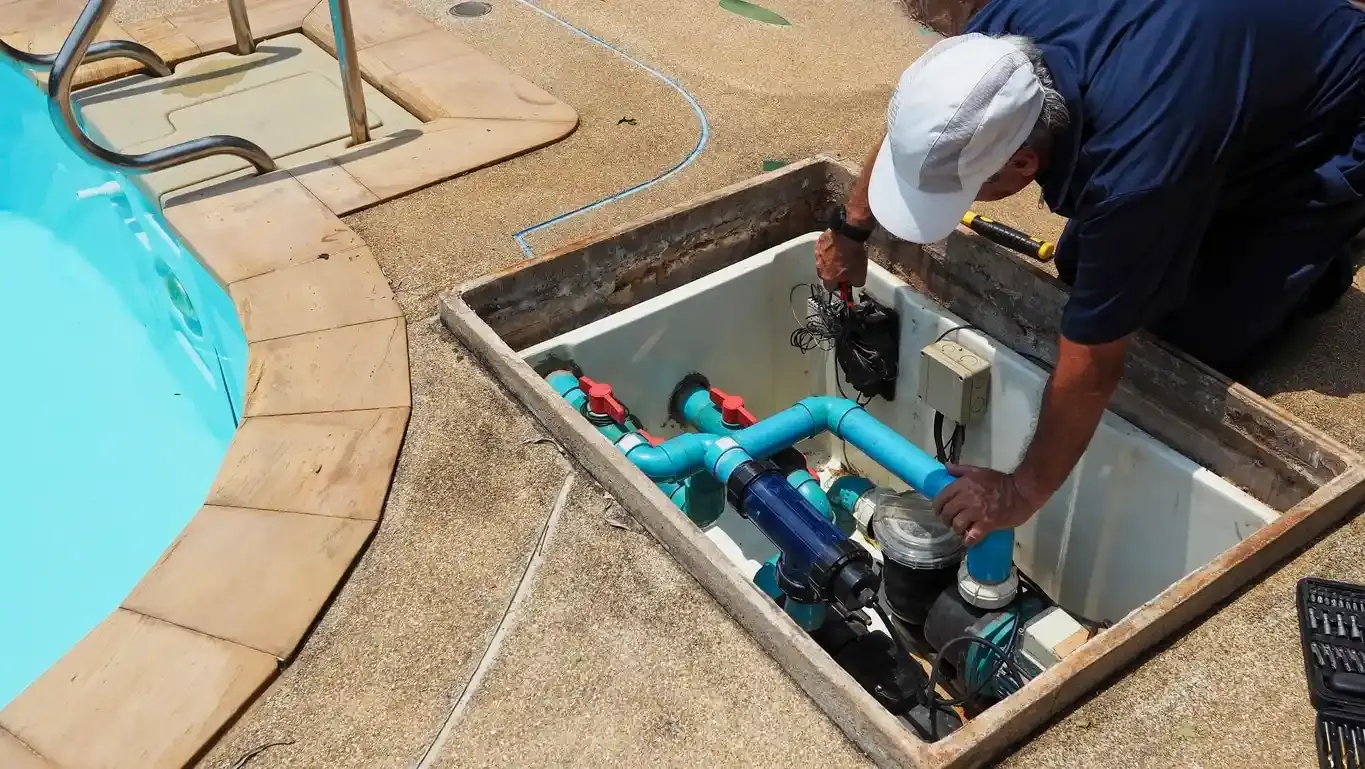
The filter tank is still holding pressure when you open it
A filter tank that has been running holds pressure even after the pump stops. Open the lid or loosen a clamp while that pressure is trapped, and the lid or clamp ring can come off hard enough to cause a serious injury. Bleed the air first: open the air relief valve on top of the filter until water runs steady, then shut the system down before touching anything. Skeet's Pool Service wrote this guide for customers in Pinellas County.
This applies to every filter type. A cartridge filter needs the tank fully depressurized before the lid comes off. A sand filter backwash releases pressure differently, and a DE filter holds residual pressure inside the grids even when the gauge reads low. Wait for the gauge to hit zero every time.
Never loosen a clamp or lid while the pump is running, even briefly to check something. That is the most common way pool owners get hurt during equipment work. If the gauge will not drop to zero, something is wrong with the valve positions or the gauge itself, and that is a stop-work point.
Power is still reaching the pump when you touch it
Pool pumps run on high-voltage power in most Florida yards, and the switch on the pump housing does not cut power to the wiring. Shut the dedicated breaker at the panel before your hands go anywhere near the motor, then verify, because a breaker panel can be mislabeled. Run through these checks before touching wiring:
- Shut the dedicated pump breaker at the panel.
- Confirm no time clock or automation system can start the pump.
- Test for power at the pump terminals, not just at the panel.
- Check what else the breaker feeds on the same circuit.
- Look for damaged conduit or wet connections before working.
GFCI protection matters here too. Outdoor pool circuits should trip on a ground fault, but an older panel may not have it, and water inside a conduit or junction box turns a small fault into a serious one. If the pump hums but will not start, the motor or capacitor is the likely problem, and that job belongs with a Pool Equipment Repair visit rather than a first attempt.
The capacitor inside the pump motor holds a charge after shutoff
Even with the breaker off, a motor capacitor can hold a charge long enough to bite you. Pool pump capacitors store enough voltage to deliver a sharp shock, and the terminals sit exactly where your hands go when you pull a motor or swap out a seal.
The safe habit is to discharge the capacitor across the terminals with an insulated screwdriver, then confirm with a meter before touching anything. If you do not own a meter or have never discharged a capacitor, that is a real reason to stop. The part is small, but the shock is not.
Capacitors are also one of the most common failure points in a pool pump. A motor that hums, trips the breaker, or starts sluggish often has a weak or swollen capacitor, and a tech can usually test and replace it in a single visit. Pinellas County homeowners who see these symptoms get a faster answer by calling Skeet's Pool Service at (727) 504-1800 than by guessing at the part.
Chemical feeders and salt cells keep dosing chlorine while you work
If the system has a salt chlorine generator or a tablet feeder, it can keep producing or releasing chlorine even after the pump stops. Breaking into plumbing downstream of a salt cell or feeder can dump concentrated chlorine into the lines, or into your face when you pull a fitting.
Turn off the salt cell at its own switch as well as the pump breaker, and let the system finish its current cycle before opening anything. While you wait, inspect the salt cell for scaling, because buildup there causes flow faults that mimic pump problems and send owners chasing the wrong repair.
Also clear the work area of stored chemicals. Mixing spilled chlorine with acid residue on fittings produces gas, and a screened enclosure traps it around you. Good airflow and a garden hose within reach are basic precautions for any repair near a feeder, not optional ones.
A gas heater turns an equipment repair into a fire risk
A gas pool heater is two systems in one box: water plumbing and a fuel line. Shutting off the pump does nothing to the gas supply, and a repair that disturbs the manifold or burners can leave a leak behind that you cannot see or hear.
Close the manual gas valve at the heater before opening the cabinet, and smell near every fitting when the work is done. Rust, dead oak leaves, and rodent nests inside heater cabinets are common in Pinellas County yards, and any of them can block venting or feed a flare-up.
If the heater needs internal work beyond clearing debris, that is pro territory. A gas connection that is not leak-tested after a repair sits inside a screened enclosure next to your house, and the risk stays invisible until it is not. Skeet's Pool Service treats gas heater internals as Pool Equipment Repair work, not a weekend project.
Open drain lines and missing drain covers create suction hazards
Any time the pump or a line is opened, the features that protect swimmers go offline. A pool with a weak, cracked, or missing VGB-compliant main drain cover can pin hair, a limb, or a swimsuit against the drain, and children are the most common victims.
Keep the whole system off while covers, valves, or pump lids are open, and make sure nobody swims or wades during the repair, even to cool off. Reassemble the skimmer basket and pump lid with clean O-rings before restart, because a lid that pops off under pressure throws water and debris across the equipment pad.
Before restarting, check that every drain cover is intact and screwed down, and that the pump primes without sucking air. A pool that keeps losing prime on restart may have an open line, a cracked fitting, or a bad lid seal that needs attention before anyone gets back in the water.
When to call a pro
Some tasks are homeowner territory: emptying a skimmer basket, a sand filter backwash, or rinsing a cartridge. Others are not, and the line is usually about what happens if you are wrong. Anything involving live wiring, gas lines, a clamp ring that will not release, a capacitor, or a motor teardown belongs with a professional.
Skeet's Pool Service handles Pool Equipment Repair across Pinellas County, from pumps and filters to salt cells and heaters, and the team sees these hazards every week. If a repair has stalled, a pressure gauge will not zero out, or you smell gas anywhere near the equipment pad, stop and call (727) 504-1800. A mid-job call is a small interruption compared with an injury or a flooded pad.
Ready to move forward? See our Pool Equipment Repair service
Written by the Skeet's Pool Service team.
7 Safety Risks to Know Before Pool Equipment Repair in Pinellas County FAQs
Should I flip the breaker or just unplug the pump to cut power?
Flip the breaker. Most pool pumps are wired directly with no plug, and the switch on the pump housing is not a safe disconnect. Shut the dedicated breaker at the panel, confirm that no time clock or automation can start the pump, and test for power at the terminals before touching any wiring.
How do I release the pressure before opening my pool filter?
Open the air relief valve on top of the filter tank with the pump off, and watch the pressure gauge. Wait until it reads zero and water runs steady from the valve before loosening the lid or clamp ring. Never open a filter tank while the pump is running.
Is it safe to repair pool equipment with water in the lines?
Usually, as long as the valves are positioned to stop flow through the equipment you are working on. Water sitting in a filter or pump is not the hazard; pressure and electricity are. Position the valves to isolate the equipment and expect some spillage when a fitting comes loose.
Can I inspect and clean my own salt cell?
A visual inspection is fine, but be careful. Shut off the cell at its own switch and the pump breaker first, and never break plumbing fittings downstream of the cell while the system can still dose chlorine. If heavy scaling is triggering flow faults, a tech can clean it without damaging the plates.
Still have questions? Contact Us